– By Trinity Gayle
For Beginners, Advanced Lifters, and Everyone In Between
If you’ve ever woken up the day after a workout and thought, “Who replaced my legs with concrete?” — congratulations. You’ve met muscle soreness.
But soreness doesn’t mean the same thing for everyone. A beginner’s soreness is very different from an experienced lifter’s. Some people feel it the next day, others two days later. Some bounce back quickly, others feel like they’ve been hit by a slow-moving truck.
Let’s break down what’s actually happening—and when soreness is normal, useful information versus a sign you need to change something.
Beginner Muscle Soreness vs. Advanced Lifter Soreness
Muscle Soreness as a Beginner
When you’re new to strength training, your body is learning a brand-new skill. Muscles aren’t used to the stress, movements are unfamiliar, and coordination is still developing. This often leads to more soreness, even from relatively light workouts. It’s not because beginners are “weak”—it’s because the nervous system and muscles are adapting.
Good news: Beginner soreness fades quickly as your body learns. Most people notice big improvements in soreness within the first few weeks of consistent training.
Muscle Soreness as an Advanced Lifter
Experienced lifters usually get sore less often, but when they do, it’s usually for a reason: New exercises or angles, higher volume than usual, longer eccentric (lowering) phases, or coming back after time off. Advanced soreness is often more localized and specific, not the full-body “everything hurts” feeling that beginners experience.
If you train consistently, soreness becomes a signal, not a requirement.
Why Some People Stay Sore Longer Than Others
Not all soreness is created equal. Recovery depends on several factors:
- Training Load vs. Recovery Capacity – You can only recover from what your body can handle. Soreness lingers when: volume or intensity outpaces recovery, sleep is limited, stress is high, or nutrition is inconsistent (especially protein).
- Movement Quality – Poor mechanics create unnecessary tissue stress. Two people can do the same workout and have very different soreness depending on form, control, and stability.
- Training History – Someone who’s trained for years has more resilient tissue than someone restarting after a long break—even if they’re the same age.
Next-Day Soreness vs. Two-Day Soreness (DOMS Explained)
Ever feel fine the day after a workout… and then suddenly sore **two days later**?
That’s called Delayed Onset Muscle Soreness (DOMS). It happens because as we work we micro-damage our muscle fibers, and inflammation shows up from high tension movements that the body hasn’t had a chance to get used to and is especially common with slow lowering (eccentric) exercises/movements.
A few timing differences worth noting; a next day sore is often from lighter or metabolic stress and “48 hour soreness” (the second day sore) that is more common with new or intense strength training. Neither is “better.” They are just different responses and everyone most likely experiences both at different times.
Soreness Changes With Age
As we get older (hello, 40+ club), soreness doesn’t mean we should stop training—but it does mean we should train smarter. Things in the body change as we age; recovery takes longer, the connective tissue adapts more slowly, warm-ups and cool-downs matter more! And sleep and stress play a bigger role in how we feel each day.
Some things stay the same, such as the ability to build strength, the benefits of lifting weights and the importance of progressive training (not doing the same movement with the same weight every time you enter the gym).
The goal isn’t avoiding soreness—it’s managing it so it doesn’t interfere with life.
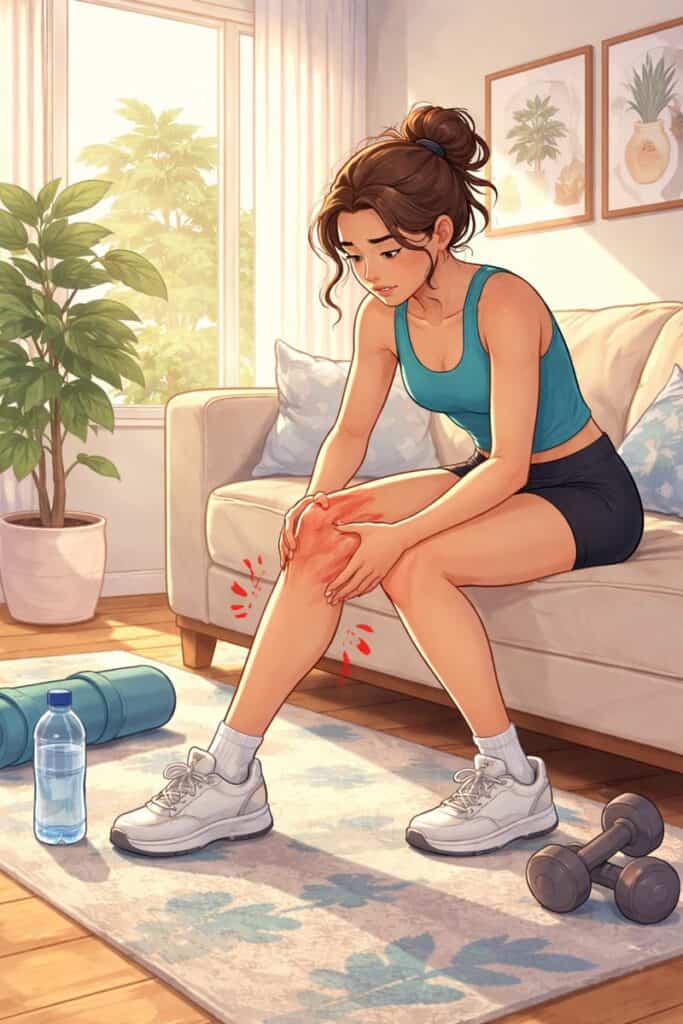
Muscle Soreness vs. Joint Soreness (Very Important Difference)
Muscle Soreness:
Usually feels dull, tight, or tender but improves with movement and light activity and usually fades within a few days. It is normal after challenging workouts. This discomfort is generally okay.
Joint Soreness:
Feels sharp, pinchy, or achy, feels worse during movement and can linger or worsens over time. It is often tied to poor loading or technique (but can be other life factors, it’s not always the workout’s fault). This is NOT something to push through. Joint soreness is your body asking for: different exercise selection, improved technique, smarter volume and intensity or possibly more recovery time.
Here is a link to another article from a sports med doctor who goes a bit deeper into good and bad muscle soreness.
https://usacheer.org/how-to-know-the-difference-between-good-and-bad-muscle-soreness?
If soreness is making stairs feel personal or tying your shoes feels like an Olympic event, don’t panic. Use this quick check before deciding whether to push, rest, or adjust.
✅ 1. Do a Movement Test
Ask: *Does light movement make it feel better or worse?*
*Feels better after 5–10 minutes of easy movement:
You’re likely dealing with normal muscle soreness. Training (with adjustments) is usually okay.
*Feels worse or sharper as you move:
That’s a pause-and-adjust signal. Don’t push through joint pain.
✅ 2. Lower the Intensity (Not the Habit)
You don’t need to skip the gym—you may just need to downshift.
* Reduce weight
* Cut volume in half
* Slow the pace
* Focus on control and range of motion
Consistency beats hero workouts. Every time.
✅ 3. Choose “Recovery-Friendly” Movement
Active recovery helps soreness resolve faster than complete rest.
Good options: Walking, easy cycling, light mobility work, gentle strength through pain-free ranges.
If it gets you warm and moving without gritting your teeth, it counts.
✅ 4. Check the Boring Stuff (That Actually Works)
Soreness hangs around longer when recovery basics are missing.
Quick audit:
* Did you sleep at least 7 hours?
* Did you eat enough protein?
* Are you under more stress than usual?
* Have you trained hard multiple days in a row?
Fixing one of these often fixes the soreness.
✅ 5. Separate Muscle Soreness from Joint Pain
This matters.
- Muscle soreness: Dull, tight, improves with movement
- Joint pain: Sharp, pinchy, unstable, or worsening
Muscles adapt. Joints complain. Listen accordingly.
✅ 6. Ask the Long-Term Question
Instead of “Can I push through this today?” ask: “If I trained like this every week, would I feel better or worse in 6 months?”
That answer is usually obvious—and very helpful.
✅ 7. Adjust the Plan Going Forward
If soreness keeps showing up too strong or too often:
* Reduce volume slightly
* Improve warm-ups
* Spread hard days out more
* Revisit exercise selection
Progress should feel challenging—not punishing.
You don’t earn extra results for suffering longer, especially after 40. The goal is to recover well enough to train again, not to limp through life proving how hard you worked.
Strong. Capable. Ready for tomorrow.
That’s the win. 💪
Here’s a guide to help you make the simple decision of “Should I train or do I need more time to recover?” Only you can answer that question, your Flower Mound coach doesn’t feel what you feel. You have to train yourself to make the right choice at the right time (not just in the gym but every area of your life).
✅ Train Today If:
- Soreness feels muscular, not sharp or joint-related
- You loosen up after a warm-up
- You can move through full ranges of motion without pain
- Energy improves once you get going
- You’re a little uncomfortable—but not compromised
How to train on sore days:
- Reduce load or reps
- Focus on quality over quantity
- Keep effort at a 6–7 out of 10
- Prioritize good movement and control
This is how experienced lifters stay consistent for decade
⛔ Rest or Actively Recover If:
- Pain is sharp, pinchy, or in a joint
- Soreness worsens as you warm up
- You’re altering your movement to avoid pain
- Fatigue feels systemic (poor sleep, high stress, low motivation)
- The same area has been sore for multiple sessions in a row
Rest doesn’t mean “do nothing.”
It means choosing recovery-forward options:
- Walking
- Mobility work
- Light cardio
- Breathing and relaxation work
These help you come back stronger instead of digging a deeper hole
⚖️ The Gray Area (Most People Live Here)
Some days you’re not broken—but you’re not fresh either.
On these days:
- Train, but shorten the session
- Skip max-effort lifts
- Avoid pushing sets to failure
- Finish feeling better than when you started
If you walk out thinking, “That helped,” you made the right call.
🚩 When to Adjust the Program (Not Just the Day)
If you’re frequently asking whether to train or rest, the issue isn’t motivation—it’s planning.
Time to adjust when:
- You’re sore every week in the same joints
- Recovery feels harder than training
- Progress has stalled despite effort
- You dread workouts instead of looking forward to them
Smart programming creates progress and recovery—especially for adults over 40.
The Big Takeaway:
Training builds strength. Recovery allows you to keep it. Soreness Is Information, Not a Goal
Being sore doesn’t mean:
* You had a “good” workout
* You’re making progress
* You need to rest for a week
And not being sore doesn’t mean: The workout didn’t work or you’re doing something wrong
The best programs—especially for adults over 40—build strength, muscle, and resilience without constantly beating you up. Because the real win isn’t being sore. It’s being strong enough to: travel without aches, hike without hesitation, pick things up (and put them down) confidently and live your life without always negotiating with your knees.
The goal isn’t to see how much soreness you can tolerate—it’s to train in a way that supports your life, your energy, and the things you love doing outside the gym.
Strong today.
Capable tomorrow.
Still moving well years from now.
That’s Serious Results training. Learn more about our Personal Training Program
Serving Flower Mound, Lewisville, Highland Village, Argyle, Bartonville areas with data-driven, truly personal training.